Smarter sensors.
Lighter hardware.
Air defenses are bombarded with sensory overload. When every second of warning saves lives, Phinorm improves detection through a simple software upgrade — faster, more accurate, ready to integrate.
Sensors change. Models break.
Neural networks often struggle to adapt quickly when operating conditions shift (environment, platform, clutter, sensor swap, domain shift). In small-sample settings, retraining costs time and compute — exactly when you can’t afford delay.
Neural networks fail to adapt quicklyRapid adaptation with trade-off free math.
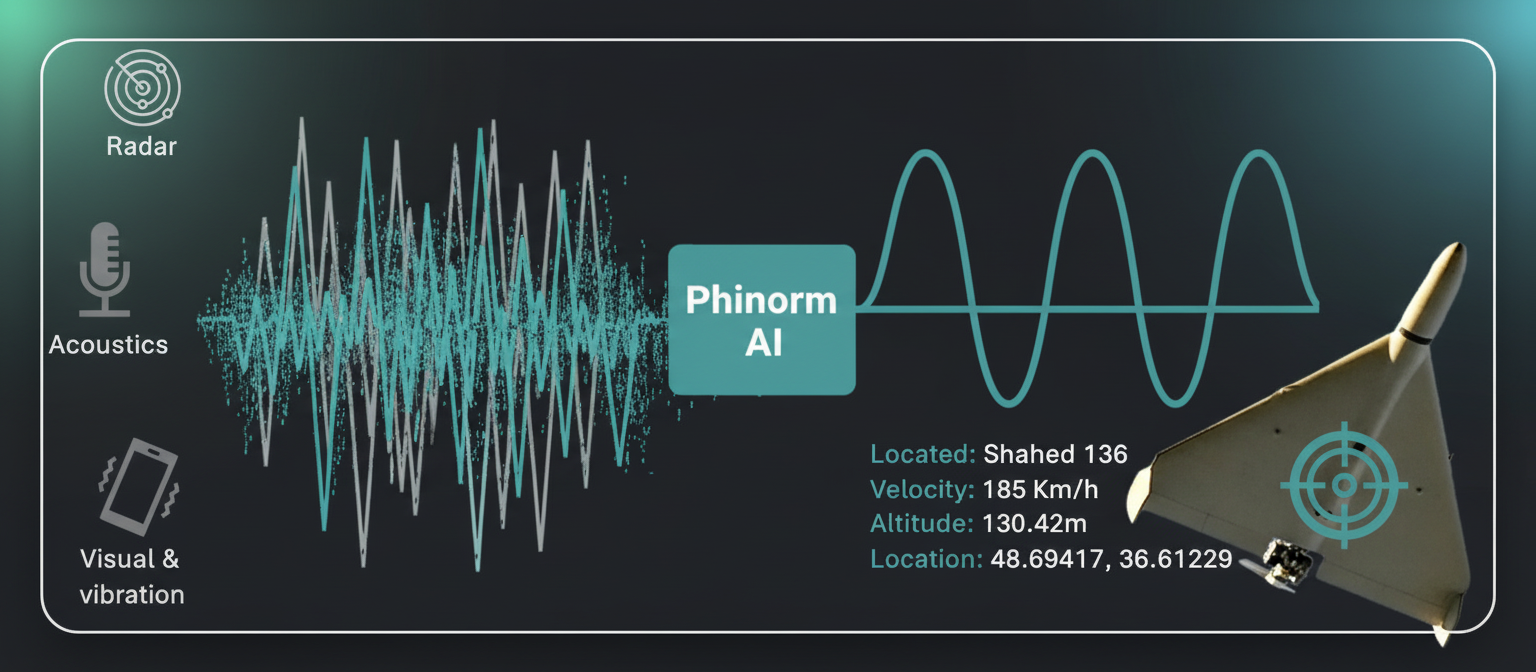
Phinorm uses a “forgotten” mathematics branch that combines with other AI approaches to converge quickly to new settings, while staying compute-efficient and deployable on any device.
Adaptive / resilient across environmentsWhy Phinorm
Better signal filtering with less compute — suitable for embedded and edge deployments.
2–4× fewer errors versus scientific benchmarks in small-sample radar classification.
Robust in changing environments — designed to work on any device.
A mathematics approach that can complement (not replace) existing ML stacks.
Position Phinorm as a drop-in software upgrade for sensing pipelines.
Radar, acoustics, visual & vibration — reuse the approach across modalities.
Small-sample bird vs drone radar classification
Neural networks fail to adapt quickly.
Best benchmark model** (ensemble with FFT).
Rapidly converges to new settings.
Leadership team
Philipp Gschoepf
Built 2 AI CoEs (250 staff), delivered 219 AI programs to $450M impact (4x ROI) in highly confidential data environments.
David Behrens
AI researcher, quant consultant at Deloitte; radar signal specialist.
John Fabros
Former P-3C Naval Flight Officer; 1,100 hrs and Air Medal recipient; led $10M+ intl defense acquisitions programs.
Active TS/SCIElina Conley
Defense go-to-market, government partnerships, and IP licensing; managed 40+ DOE SBIR/STTR Phase I/II projects.
Hardware partners
We are seeking partners in sensing hardware to conduct a hackathon helping you:
- Turn commodity sensors into premium products
- Collaborate with DIU, AFRL, ONR, FUZE, DIU or similar
- Compete with fully-integrated defense primes
Data partners
We are open to data challenges do demonstrate the superiority of our aglorithm to you:
- 45% less errors on detecting UAVs from audio data
- 75.5% more accurate detection on radar data
- Multi-sensor fusion suitable
Research hubs
For NATO-aligned partner labs we offer:
- A completely new approach, originating from a long-forgotten branch of mathematics
- Suitable to detect UAV locations from cellphones and other civilian sensors
- Ignores accuracy VS SWaP trade-off. We do better on all dimensions
Let’s talk integration
Share your sensor modality, compute constraints, and deployment environment. We’ll propose a quick test plan.
Email:
philipp@phinorm.com